

Key takeaways
- Muscle grows through progressive overload: more weight, reps or sets over time.
- Protein (1.6–2.2 g/kg) and a slight calorie surplus supply the building blocks and energy.
- Recovery & sleep are not a bonus – muscle grows during rest, not during training.
- Realistic: beginners ~0.5–1% of body weight per month; much slower over time.
- Patience and consistency beat any "secret program".
Building muscle looks complicated from the outside – but it is not. At its core, only three things matter: the right training stimulus, enough building blocks and enough recovery. Understand those and apply them consistently, and you grow. The rest is fine-tuning.
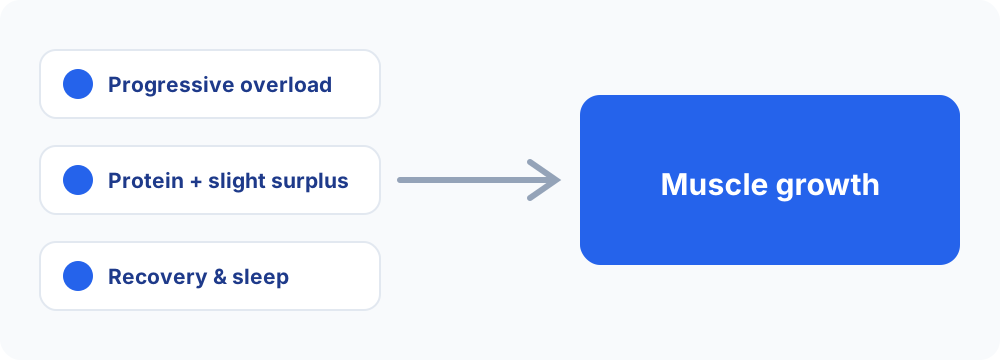
How muscle actually grows
Muscle grows when you challenge it regularly and then give it recovery and building blocks. The key stimulus is mechanical tension: when a muscle works against a challenging resistance, it triggers adaptation signals that make it bigger and stronger. For this to continue, the stimulus has to increase over time – otherwise the body adapts and progress stalls.
Training: progressive overload is everything
The most important lever is progressive overload: doing more over weeks and months – more weight, more reps or more quality sets. Practical guidelines:
- Volume: roughly 10–20 hard sets per muscle group per week.
- Reps: growth happens across a wide range (about 5–30 reps), as long as sets are taken close to failure (1–3 reps left in the tank).
- Frequency: training each muscle ~2× per week beats 1× at the same volume.
- Exercise choice: compound lifts (squat, deadlift, press, row, pull-up) as the base, isolation work as a supplement.
- Technique & range of motion: clean reps through the full range beat momentum and ego weights.
Nutrition: building blocks and a small surplus
Without enough protein, the building blocks are missing: about 1.6–2.2 g per kg of body weight per day, spread across several meals. For maximum growth, a slight calorie surplus helps (around +200–400 kcal per day) – more than that mostly adds fat, not muscle. Carbs fuel hard training, fats cover basic functions. If you want to lose fat at the same time, see body recomposition.
Recovery: muscle grows during rest
The growth stimulus is set in training – the actual adaptation happens afterwards. That makes sleep (7–9 hours), rest days and a reasonable stress level genuine performance factors. Train constantly sleep-deprived and you build slower and risk injury. Every few months, a lighter deload week can help shed accumulated fatigue.
What is realistic?
Muscle grows slowly – that is normal. Beginners ("newbie gains") often manage ~0.5–1% of body weight per month; after the first year the pace roughly halves, and it slows further from there. Women build more slowly in absolute kilos (less testosterone) but similarly well in percentage terms. And there is a natural ceiling: an FFMI around 25 (men) or 22 (women) is considered very high without aids.
Common mistakes
- No real progression: same weights and reps forever → no stimulus.
- Program hopping: constantly switching, never sticking with anything.
- Too big a surplus: a "bulk" with lots of fat gain instead of lean growth.
- Too little protein or sleep.
- Only watching the scale: strength gains, measurements and photos show growth better – see measuring body fat.
Bottom line
Building muscle is no secret: train progressively, eat enough protein with a small surplus, sleep well – and keep at it. Measure progress through strength, measurements and body composition rather than the daily scale.
Note: general information, not individual training or medical advice. With pre-existing conditions or pain, seek professional guidance first.