
Key takeaways
- The scale shows only total weight – body fat percentage separates fat from muscle and water.
- What matters is almost always the trend over weeks, not a single reading.
- Photo estimate: convenient, anytime, ideal for tracking – but it stays an estimate.
- Caliper & BIA scale: practical day to day, but error- or hydration-dependent.
- DEXA: the gold standard for an accurate one-off measurement, impractical for everyday use.
- Consistency beats precision: always measure under similar conditions.
How much of your weight is actually fat – and how much is muscle, water and bone? That is exactly what body fat percentage answers, making it one of the most useful numbers when you want to change your body. The good news: you do not need a lab. The honest news: no at-home method is perfect – which one is right for you depends on what you need.
Why the scale alone misleads you
Two people at the same weight can look completely different, depending on how much muscle and fat they carry. On top of that, body weight swings a kilo or two daily from water, salt, carbs and digestion. When you lose weight you want to lose fat and keep muscle – the scale cannot tell them apart. Body fat percentage can, and it shows whether your change is heading the right way.
The methods compared
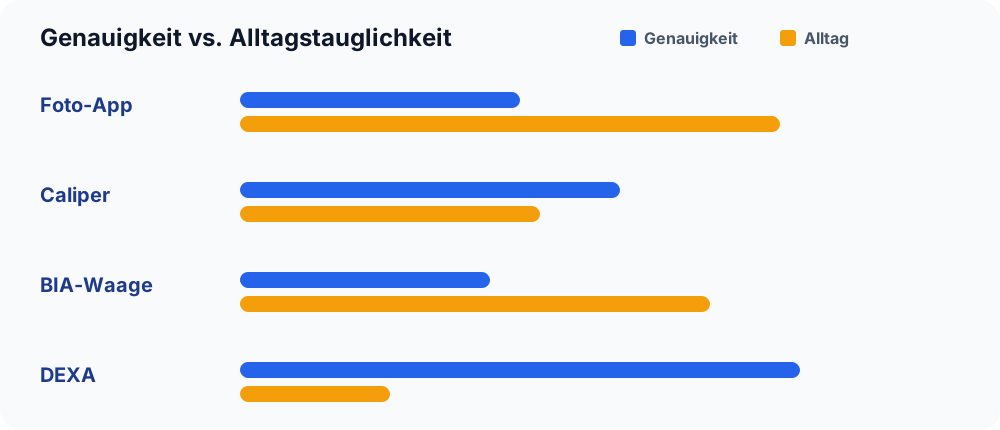
The common approaches differ mainly in accuracy, effort and everyday usability.
Photo estimate (app)
You take a photo and an AI estimates your body fat from visible cues such as fat distribution and muscle definition. The big upside: no device, results in seconds, repeatable anytime – perfect for capturing the trend regularly. It stays an estimate: lighting, pose and image quality affect it. But shoot consistently and the trend is surprisingly stable.
Caliper (skinfold)
A caliper measures skinfolds at defined sites and estimates the percentage from them. Quite usable and cheap with practice and consistent technique. Weakness: as soon as sites, pressure or the person measuring change, the values drift – and measuring yourself cleanly is hard.
BIA – body fat scales and handhelds
These send a weak, imperceptible current through the body and estimate composition from it. Very convenient at home, but heavily dependent on hydration: water, meals, alcohol and training shift the readings noticeably. Inaccurate as a snapshot, usable as an always-measured-the-same trend.
DEXA, Bod Pod & co.
The DEXA scan is an X-ray method that separates bone, muscle and fat and is considered the reference or gold standard – very accurate, but it involves an appointment, cost and a small radiation dose, so it is not for weekly checks. Similarly accurate but rarer and more expensive are the Bod Pod and underwater weighing, which measure via body volume.
Which method for whom – and how to measure reliably
For a one-off, most accurate baseline, DEXA is the first choice. For a regular everyday trend, the photo estimate or – with practice – the caliper work well. If you want convenience at home and accept some noise, reach for a BIA scale. Many combine sensibly: an accurate reference once or twice a year, a convenient trend in between.
What matters most, though, is not the method but consistency: always measure at the same time of day (ideally morning, fasted), at similar hydration, and for photos with the same pose, distance and lighting – and regularly rather than daily. The most common mistakes are the opposite: comparing values across methods directly (each has its own "zero point"), chasing daily noise, and expecting medical precision from an at-home method.
Bottom line
The "best" method is the one you keep up consistently. For most people that is a convenient approach like the photo estimate – topped up with an occasional DEXA reference when you want precision.
Note: all at-home methods give estimates, not a medical diagnosis. For health questions, consult a medical professional.