Key takeaways
- GLP-1 medications mimic a gut hormone that curbs appetite – so you eat less almost on autopilot.
- Semaglutide (Ozempic, Wegovy, Rybelsus) is a single GLP-1 agonist; tirzepatide (Mounjaro, Zepbound) is a dual GIP/GLP-1 agonist and shows the strongest weight loss so far.
- Typical trial results alongside lifestyle change: liraglutide ~7%, semaglutide ~15%, tirzepatide ~20–22%.
- Side effects are mostly gastrointestinal; part of the weight lost can be muscle.
- Approved mainly for type 2 diabetes or obesity, not as a lifestyle shortcut – and prescription-only.
Few topics in weight loss are as hyped – and as misunderstood – as GLP-1 medications. The names alone (Ozempic, Wegovy, Mounjaro, Zepbound) get mixed up constantly, even though they fall into just two active ingredients. This guide explains how they work, how the main drugs differ, what results are realistic, and what to watch out for.
How GLP-1 medications work
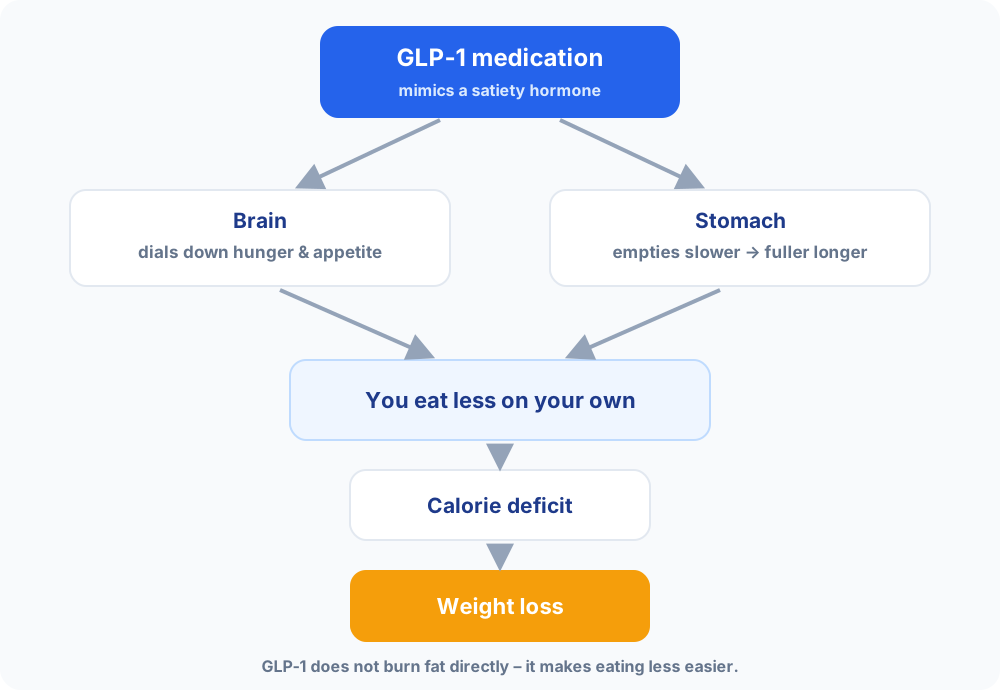
GLP-1 receptor agonists mimic GLP-1, a hormone your gut releases after eating that signals fullness and helps regulate blood sugar. They were originally developed for type 2 diabetes; several are now also approved specifically for weight management, and the newest drugs target a second hormone receptor (GIP) as well.
Two mechanisms do the heavy lifting: the drugs slow how fast your stomach empties (you stay full longer) and they act on appetite centers in the brain (you feel less hunger). The result is that you eat less without white-knuckle willpower – which creates the calorie deficit that drives weight loss. Important: they do not burn fat directly; they make eating less easier.
The active ingredients compared
| Active ingredient | Brand names | Type | Administration | Typical weight loss* |
|---|---|---|---|---|
| Semaglutide | Ozempic, Wegovy, Rybelsus | GLP-1 (single) | Weekly injection (Rybelsus: daily pill) | ~15% |
| Tirzepatide | Mounjaro, Zepbound | GIP + GLP-1 (dual) | Weekly injection | ~20–22% |
| Liraglutide | Saxenda, Victoza | GLP-1 (single) | Daily injection | ~7% |
| Dulaglutide | Trulicity | GLP-1 (single) | Weekly injection | Modest (diabetes-focused) |
| Retatrutide (in trials) | Not yet approved | GLP-1 + GIP + glucagon (triple) | Weekly injection | Very high in studies |
*Average reduction in clinical trials, alongside diet and exercise. Individual results vary widely.
Semaglutide – Ozempic, Wegovy, Rybelsus
The best-known agent, a single GLP-1 agonist. The catch: same molecule, different brands. Ozempic is approved for diabetes, Wegovy for weight loss (a higher dose), Rybelsus is the oral form – a daily tablet instead of a weekly injection. In the STEP trials, Wegovy-dose semaglutide produced around 15% average weight loss.
Tirzepatide – Mounjaro, Zepbound
The newer dual agonist: it activates both the GLP-1 and the GIP receptor. Mounjaro is approved for diabetes, Zepbound for weight loss; both are weekly injections. In the SURMOUNT trials it reached up to roughly 22.5%, and head-to-head it produced more than semaglutide (about 22% vs 15%) – making it the most effective option currently available.
Liraglutide and older options
Liraglutide (Saxenda for weight, Victoza for diabetes) is an earlier GLP-1 agonist requiring a daily injection, with more modest results (around 7%). Dulaglutide (Trulicity) is a weekly GLP-1 agonist used mainly for diabetes.
On the horizon: triple agonists
The next generation adds a third target: retatrutide activates GLP-1, GIP and glucagon receptors and has shown very large weight loss in early trials – but it is still investigational and not yet approved.
Effectiveness, benefits and limits
On average, more receptor targets have meant more weight loss (liraglutide < semaglutide < tirzepatide). But "best on paper" is not the same as "best for you" – the right choice depends on your health, tolerance, availability and cost, and it is a medical decision. Beyond the scale, these drugs improve blood sugar in type 2 diabetes, and for some agents there is evidence of cardiovascular benefit in higher-risk patients. Whatever the drug, how good and how durable the result is comes down to the fat-loss fundamentals.
Side effects, muscle and stopping
The most common side effects are gastrointestinal: nausea, bloating, constipation or diarrhea, especially early on and usually easing as the dose is raised slowly. Rarer but more serious: gallbladder problems and pancreatitis; not suitable for everyone (e.g. with a family history of certain thyroid cancers). That is why they belong under medical supervision.
As with any rapid weight loss, part of what you lose is muscle, not just fat. To protect lean mass, prioritize enough protein (about 1.6–2.2 g per kg) and strength training; tracking your trend catches muscle loss early – see how to measure body fat. And the drugs only work while you take them: after stopping, appetite – and without changed habits, some weight – tends to return.
Frequently asked questions
Is tirzepatide better than semaglutide?
Head-to-head, tirzepatide produced more weight loss on average. But the right choice depends on your health, tolerance, availability and what your doctor recommends.
Injection or pill?
Most are weekly injections. Rybelsus (semaglutide) is a daily tablet; oral options for weight loss are in development.
Will I keep the weight off?
Largely depends on your habits. Stopping tends to bring appetite – and some weight – back.
Will I lose muscle?
Some lean-mass loss is normal with fast weight loss. Enough protein and regular strength training meaningfully reduce it.
Bottom line
GLP-1 medications are a genuinely powerful tool – especially the dual agonist tirzepatide – but they are a medical decision, not a lifestyle shortcut, and they work best alongside solid habits.
Important: This article is general information and not medical advice. GLP-1 medications are prescription-only. Decisions about starting, dosing or stopping belong with a medical professional.